
A crowded bathroom shelf can complicate a routine. Before adding another serum, put the products you already own on one list. The useful question is not whether your collection looks minimal enough. It is whether you understand each product’s purpose, instructions, and place in your routine.
Your Skin Isn’t Lasagna!
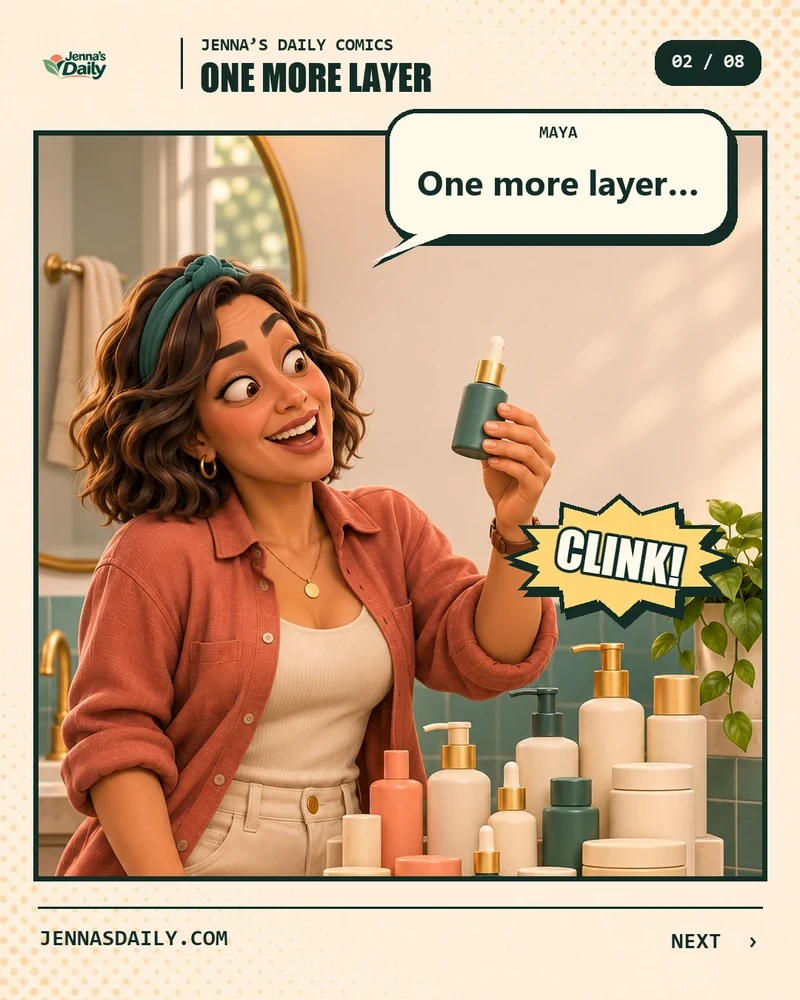
Maya is about to add one more step to her skincare routine. Read all eight panels to see what Nina spots on the bathroom counter.







Start with purpose, not a product-count target
There is no product-count rule here that tells everyone which routine is right. Cleveland Clinic describes simpler routines and skin-barrier care among ongoing skincare trends, but a trend cannot assess your skin. The American Academy of Dermatology notes that using several products can increase irritation and cost. A short routine can still contain something unsuitable for you.
Set aside a few minutes to read the packages. Include cleansers, moisturizers, sunscreen, masks, scrubs, toners, and treatments you use only occasionally. Record prescribed products too, so your clinician can see the full picture; this checklist is not a reason to change a prescription.
Copy this four-column inventory
Use one row per product, even if two bottles look almost identical. Copy the stated purpose and directions rather than guessing from words such as glow or renewal. If an instruction is unclear, write a question instead of inventing a schedule.
| Product name | Purpose on the label | Label frequency / directions | Question to check |
|---|---|---|---|
| [Your cleanser] | [Copy its stated purpose] | [Copy the directions] | [Does another product repeat this step?] |
| [Your moisturizer] | [Copy its stated purpose] | [Copy the directions] | [Does it suit the way I use it?] |
| [Your sunscreen] | [Copy its stated purpose] | [Copy application / reapplication directions] | [Does the label give the protection I need?] |
| [Your treatment or occasional product] | [Copy its stated purpose] | [Copy directions and warnings] | [What should I ask my clinician or pharmacist?] |
Photograph the labels if the containers are awkward to carry to an appointment. Keep this inventory for your own use; you do not need to post photographs of your skin or personal health details online to organize a shelf.
Look for repeated steps, not universal ingredient bans
For example, an exfoliating cleanser and a separate exfoliant may both add exfoliation to the same evening. That is a question worth noticing, not proof that every pair of products in the same category must never be combined. Concentration, formulation, frequency, skin type, and professional instructions matter.
The AAD advises considering retinoid medicines and products containing retinol or benzoyl peroxide before exfoliating, because exfoliation may worsen dryness or other problems. Do not build a stronger routine by automatically stacking another exfoliating step. Ask about combinations you do not understand.
Keep the basic jobs visible
The AAD’s budget guidance centers on cleansing, moisturizing, and sun protection. Those jobs can be easier to identify than a long list of marketing categories. A product with more than one function may cover overlapping jobs, but check its actual label rather than assuming every moisturizer provides sunscreen protection.
For sunscreen, the AAD recommends broad-spectrum protection, SPF 30 or higher, and water resistance. Follow application and reapplication directions, and use shade and protective clothing too. A larger skincare collection does not replace those practical sun-protection habits.
Give a new product a deliberate place
Write down which job a possible purchase would fill before adding it. Is it replacing something you finished, repeating a step, or addressing a question that needs professional assessment? This small pause separates the appeal of a new package from a reason to use what is inside.
The AAD provides small-area testing instructions for new skincare products. Follow that guidance and the product’s directions rather than immediately adding several new products to your face. Home testing cannot guarantee that a product will never cause a reaction or replace medical patch testing when it is needed.
Treat irritation as information, not an achievement
Stinging does not establish that a product is delivering a useful result. If a new nonprescription skincare product causes a reaction, AAD guidance is to gently wash it off and stop using it. Seek professional advice for a severe reaction or symptoms that do not settle, or when you cannot identify what is causing the problem.
For symptoms involving a prescribed treatment, contact the prescriber rather than using this article to change the plan. Bring your inventory, labels, and a simple account of when the problem began. The aim is to make that conversation clearer, not to diagnose a damaged skin barrier from a video or product list.
Before buying another serum
- Name the job you want the product to do.
- Check whether an existing product already covers that step.
- Read frequency, application directions, and warnings.
- Write down any combination or irritation question for a qualified professional.
Keep the completed inventory somewhere useful and revisit it when a product changes. Understanding a routine can be a better next step than expanding it. The goal is an informed shopping decision, not a perfect shelf or a promise of flawless skin.
Sources & further reading
- American Academy of Dermatology: Skin care on a budget ↗
- American Academy of Dermatology: How to safely exfoliate at home ↗
- American Academy of Dermatology: How to test skin care products ↗
- American Academy of Dermatology: How to select a sunscreen ↗
- Cleveland Clinic: Skin Care Trends: What’s New and What To Avoid ↗
- American Academy of Dermatology: Skin flooding ↗
Manufacturer information, when cited, is a commercial source. It does not establish that a finished product is clinically effective.